Your Cloud Provider Doesn’t Work for You. It Works on You.

Every month, you pay $60 to $100 for the privilege of storing your data on someone else’s computer. Google One. iCloud. A password manager. Three streaming services. A VPN. A backup tool you forgot you had.
You call these subscriptions. The companies behind them call it recurring revenue. The difference in framing matters.
The Product Is You
Deloitte’s 2025 Digital Media Trends report found that the average U.S. streaming household pays $69/month across four video services, up 13% year-over-year. That does not include cloud storage, password managers, VPNs, or backup services. Stack those on top and most families are clearing $100/month without thinking about it.
Press enter or click to view image in full size
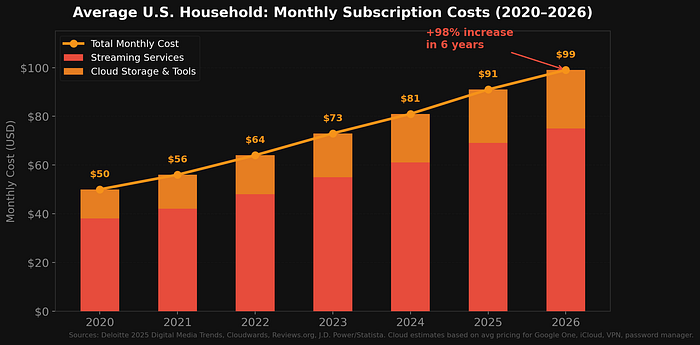
Average U.S. household subscription costs have nearly doubled since 2020, rising from $50 to $99/month. Sources: Deloitte 2025 Digital Media Trends, Cloudwards, Reviews.org.
But the money is not the real cost.
The real cost is that every file you upload, every photo you sync, every password you store, and every message you send lives on infrastructure controlled by companies whose business model depends on collecting, analyzing, and monetizing your behavior. Meta’s $1.3 billion GDPR fine was not an accident. It was the system working as designed.
In 2026, with AI models being trained on user-generated content from every major platform, the question is no longer whether your data is being used. It is how aggressively.
The Alternative That Finally Works
A home server is a small computer that sits in your house, runs 24/7, and hosts the same services you currently rent from the cloud. File storage. Password management. Photo backups. Media streaming. Even a private AI assistant that never sends your prompts to anyone.
This is not new technology. What is new is that setup no longer requires a computer science degree.
Operating systems like StartOS have reduced the process to: plug in hardware, open a browser, install apps from a marketplace. No terminal. No Docker. No weekend lost to debugging a reverse proxy. Over 50 one-click services are available, from Nextcloud (your own Google Drive) to Vaultwarden (your own password manager) to Jellyfin (your own Netflix for content you own) to Ollama (your own local AI).
The Start9 Server One, a compact mini PC with an AMD Ryzen 7 6800H and up to 4 TB of NVMe storage, starts at $749. That is roughly eight months of average subscription costs. After that, you are saving every single month, permanently.
Press enter or click to view image in full size
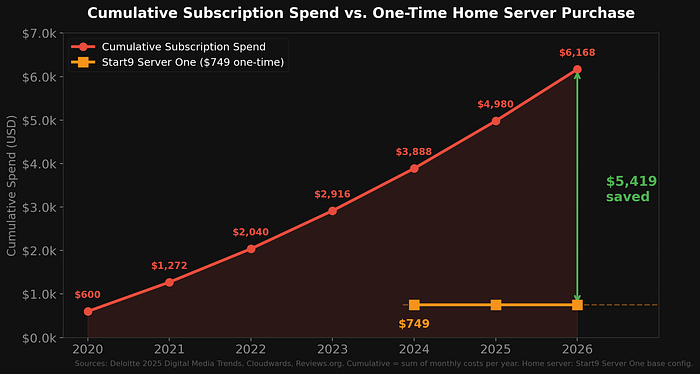
Six years of cloud subscriptions: $6,168. One home server: $749. The average household saves $5,419 by switching to self-hosted infrastructure.
This Is Not Just About Storage
The people I talk to who run home servers do not do it to save money, although that helps. They do it because they got tired of being the product.
They got tired of Google scanning their documents. They got tired of iCloud training models on their family photos. They got tired of password managers getting breached because a single centralized vault is a single point of failure. They got tired of streaming services removing content they paid to access.
A home server does not solve every problem. You still need internet. You are responsible for backups. But for the things that matter most (your passwords, your photos, your files, your messages, your financial data), owning the hardware means owning the outcome.
For anyone running Bitcoin infrastructure, a home server also means running your own full node, your own Lightning channels, and even your own solo mining pool. That is a level of sovereignty that no cloud service will ever offer. Solo Satoshi carries the Start9 Server One as the first official U.S. distributor for Start9 Labs, shipping same-day from Houston with a 2-year warranty.
The Shift Is Already Happening
A viral post on Hacker News in January 2026 declared it “the year of self-hosting.” The awesome-selfhosted GitHub repository has over 200,000 stars. Home Assistant has over 1 million active installations. The tools are mature. The hardware is silent and affordable. The operating systems no longer require you to become a sysadmin.
The only thing left is the decision.
If you want the full breakdown of what a home server replaces, how to set one up, and every app available on StartOS, I wrote a comprehensive guide here.
The cloud was always just someone else’s computer. In 2026, you can finally afford your own.


